
Tsukiji Outer Market #
The Japlan had Tsukiji down as a fish market - specifically, the kind you’ve probably seen in documentaries, with men in rubber boots shouting prices over enormous frozen tuna and a legendary auction that starts before most people are awake. This was accurate, in the sense that the English-language information you find online still leads with all of that, as though nothing has changed since 2017.
We went to the market for two reasons: it was the touristy thing to do, and we’d been told the wagyu beef skewers were not to be missed. The tuna auction was a secondary hope - exciting in theory, slightly terrifying in practice, because the market’s website runs on a level of rules-based anxiety that I was not prepared for. Don’t eat while walking. No photos, no video. Don’t touch the food. Don’t try to haggle. Professional buyers only before 9am. I’m fairly confident most of this rulebook exists because of influencers, but that doesn’t make it any less effective at making a tourist feel like a liability before they’ve even arrived. I was genuinely nervous about accidentally committing a social gaffe at Tsukiji.
From the outside, Tsukiji presents itself as something between a market and a fortress - a dense cluster of stalls and structures with entrances that were difficult to read as public or staff-only, and I was reluctant to experiment. We stuck to the perimeter at first, where shops bordered the street and the threshold was obvious, and waited for the crowd to fill in enough to give us better direction about where we were and weren’t supposed to go.
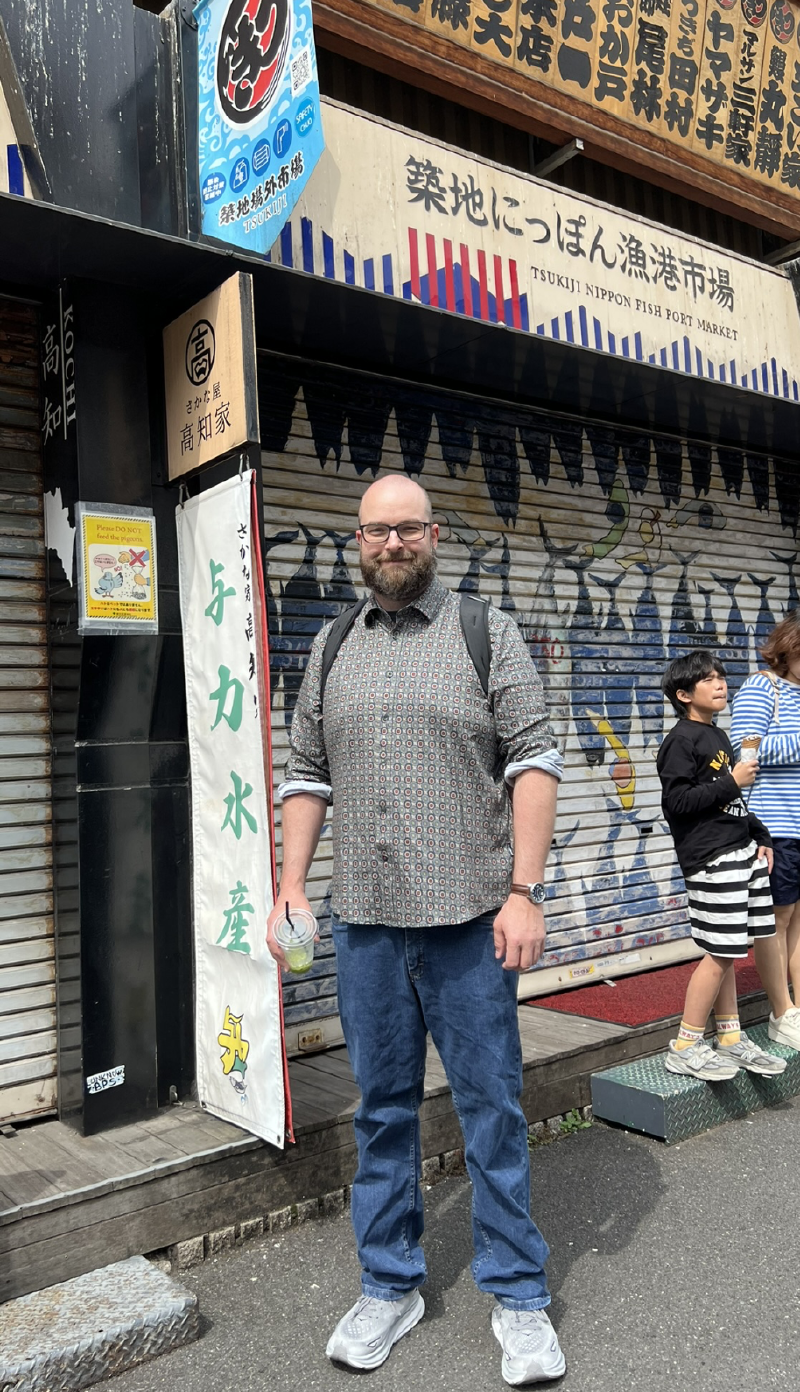
It was somewhere in this cautious perimeter shuffle that the first doubt crept in. This didn’t look anything like what I’d been picturing. Where were the giant tunas? Where was the auction? Were they closed? Had we gone to the wrong place entirely? I knew there was food here - the vendors accessible from the street made that much obvious, which was fortunate given that the family had started making pointed observations about being hungry - but the cinematic fish market experience I’d mentally constructed was nowhere to be found.
As it turns out, what I’d researched online was slightly out of date. In reality, the inner market and the tuna auction moved to Toyosu back in 2018. Before we’d left Canada, I’d made some quiet promises to my family about the tuna situation, and I was quietly relieved not to have to answer for them.
Breakfast came first. We spotted the counter shop on the perimeter of the market, easily accessible from the street, and stopped mostly because we were hungry and it looked right. By this point in the trip we’d been burned by tourist-trap pricing a few times already and were actively looking for the opposite - somewhere that felt like it existed for the people who actually live here rather than the people who’d just arrived with a Japlan and a camera. This place felt like that. Small, intimate, countertop seating only, the kind of spot you’d walk past without a second glance if your stomach wasn’t already making decisions for you.
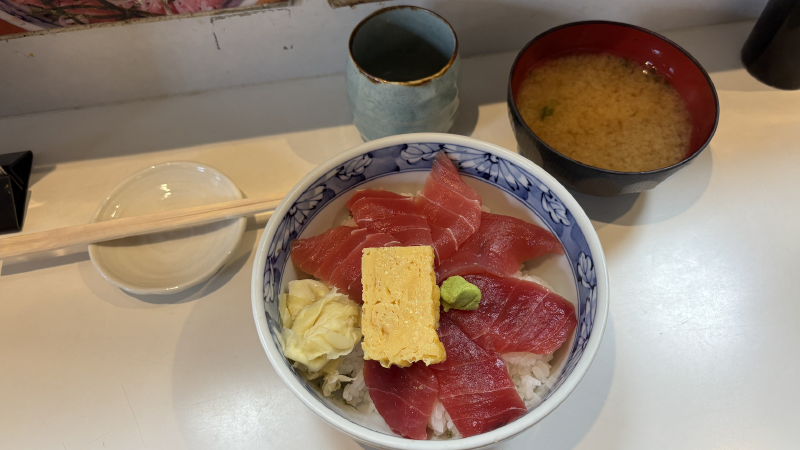
The menu had pictures rather than English, which was exactly enough to get us seated and pointed at the right things. What arrived - sashimi, rice, miso soup - was some of the best food of the entire trip. It wasn’t Jiro Dreams of Sushi intimate, nobody was standing over us gauging our reaction, but it was as close as we got in Japan to that specific feeling: no chain, no tourist infrastructure, just a simple menu, simple food, and someone who had clearly been doing this exact thing in this exact spot for a very long time with nothing left to figure out about how to do it well.
After breakfast, crowds had started to arrive which meant more shops started opening their doors. I spotted a coffee shop and wanted to check it out - the kids didn’t care about getting a coffee, but when they discovered the same shop had ice cream, the decision was made. After coffee, we wandered the market - checking out the various stalls and shops selling vegetables, meats, seafood and assorted wares. At one point, I ducked into a shop selling Japanese chef’s knives because I had a “well, if I’m here” feeling about it. I saw the price on one knife, said “nope, not today” quietly to myself, bowed, and left as fast as dignity allowed.
The kids spotted the vendor selling ichigo ame before I did. I’d never heard of ichigo ame before, which turned out to be candied strawberries on a skewer. The vendor treated the entire transaction as a performance, calling out to the crowd with the kind of practiced energy that turns a simple snack stand into a small show. I shouldn’t be surprised to learn that my kids - both perpetually online - were not only familiar, but extremely excited to try this viral treat. They’d already had ice cream, but they insisted they had room for candied strawberries. I have video of him doing his thing and I genuinely don’t know if I can do it justice in writing, but the short version is that buying a candied strawberry from this man felt like watching someone who’d found the exact right amount of theatre for the product he was selling - not so much that it felt forced, just enough that you understood half of what you were paying for was the performance itself.
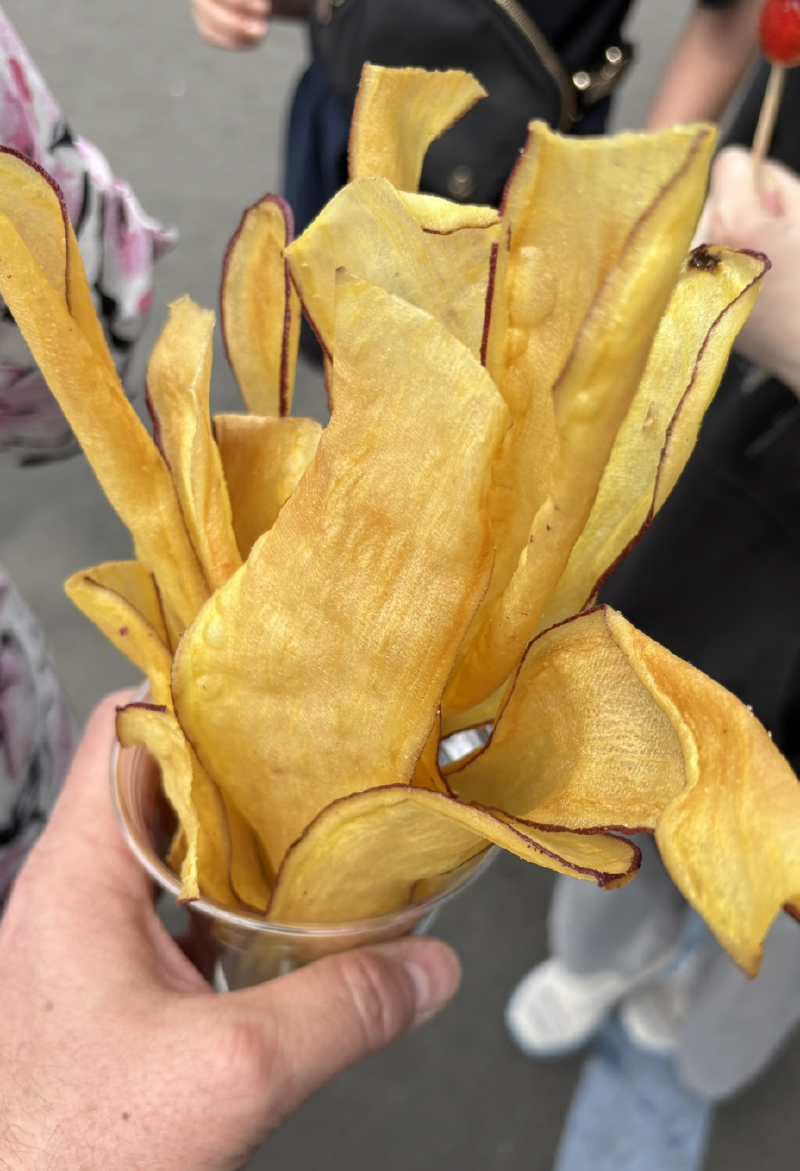
We also picked up fried sweet potato from another vendor doing his own version of the same showmanship - thinly sliced and fried, that’s it, no coating or syrup, just a giant sweet potato chip roughly the size of a Nerf football. Not greasy. Just a nice, slightly sweet crispiness, served with a bit of flair by someone who clearly understood that the flair was part of the product. There was no possible way we were going to walk and eat our haul (while the Japanese rule against eating and walking didn’t appear to apply to the market, I wasn’t taking any chances). We found a spot to sit and eat, watching the crowd form and the vendors performing their one-man acts, trying to entice people to try their products.
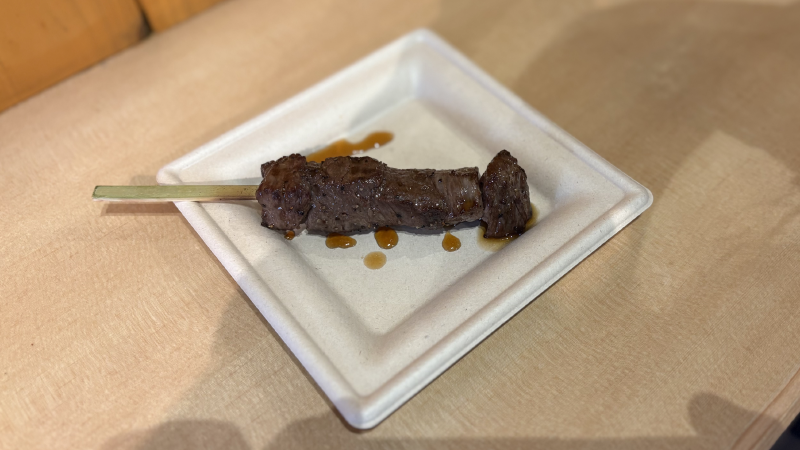
Sensing the kids were reaching their breaking point, we decided that we should locate the wagyu beef skewers and make our exit. After evaluating the prices, we settled on one skewer for the four of us - which meant one cube each. At that price point, this was an experience to have, rather than a habit to form. My wife and I ate ours slowly, with the appropriate reverence. My kids ate theirs with the polite indifference of teenagers who understand intellectually that this is expensive steak and emotionally that it’s still just meat on a stick - “yeah, this is good, wow that’s a lot of money per bite, can we get ice cream now.” Worth every yen either way. And with that, the mission was essentially complete. We looked at each other: we good? Yes. Okay, let’s go. The wagyu was the whole reason we were there, and it had been satisfied.
By midday we’d eaten our way through a genuinely impressive amount of the market and hit a wall - the specific kind of food coma that arrives unannounced and demands respect.
The Hours We Can’t Quite Account For #
Between Tsukiji and our timed entry slot at TeamLabs Planets that afternoon, we went back to the hotel to change - jeans aren’t the right call for what was coming, for reasons I’ll get to - and almost certainly made a quick pass through Akihabara on the way, because one of the subway lines we regularly used stopped there right before our station, and at this point in the trip “get off, speedrun the figure stores looking for Monoma, get back on” had become something close to a reflex.
We arrived at TeamLabs hungry, which in retrospect was a planning failure. There was a massive outdoor barbecue setup near the Planets entrance that gave us pause - it looked like something that had been airlifted in from North America and set down, slightly confused, in the wrong country. We genuinely considered it, then talked ourselves out of it for a combination of reasons: we couldn’t tell how long a sit-down meal would take, we weren’t sure what it would cost, and my North American brain at one point decided there was a non-zero chance this was a private event - a wedding reception, maybe, or a corporate function - despite the complete lack of evidence for that theory. In the end it was probably just a barbecue place. My brain doesn’t always compute correctly under hunger and humidity.
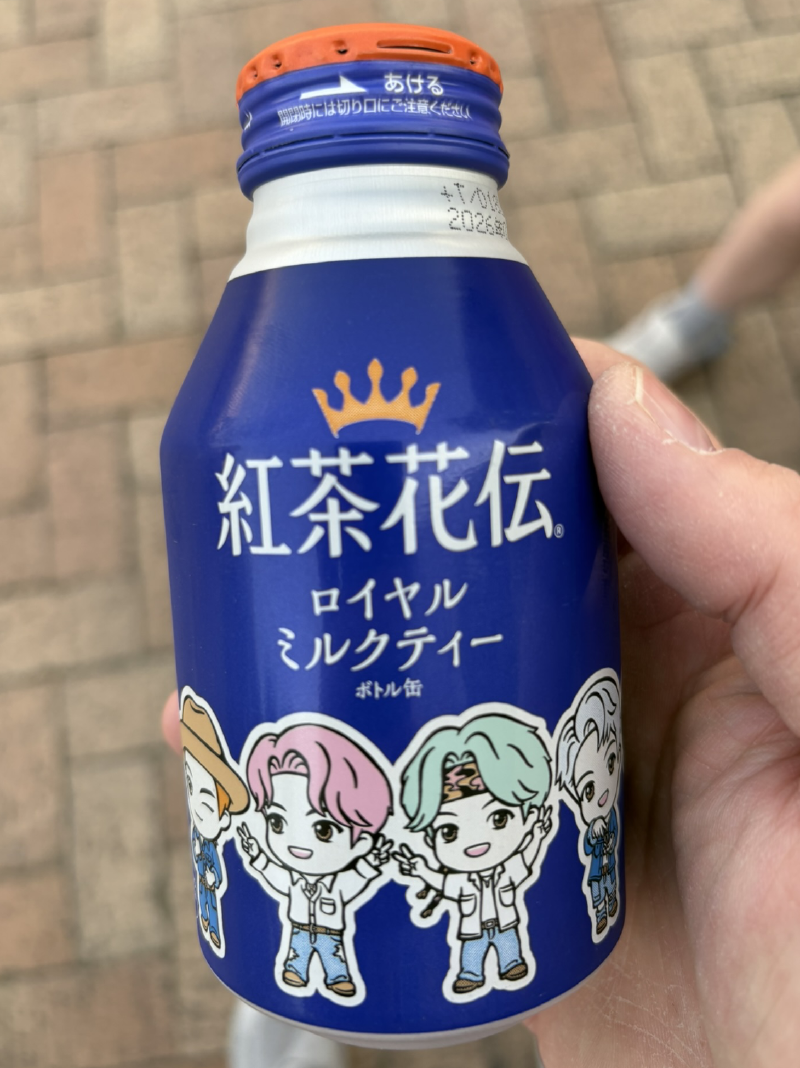
Instead, we killed time before our entry window opened by finding the café attached to the nearby soccer fields, looking at the line, saying something approximately equivalent to “holy crap, not today,” and buying drinks from a vending machine beside the pitch instead. Dinner after Planets turned out to be 7-Eleven. Later, when fact checking this post, I’d learned the barbecue place we’d walked past is called Wildmagic Rainbow Farm, adveristing “funky outdoor dining with an urban backdrop.” There’s also something called Love Kingdom BBQ at the same location. I don’t know what we were thinking.
TeamLabs Planets #
TeamLabs Planets is on the Toyosu waterfront, in an area that feels entirely planned and entirely modern - reclaimed land most likely, given the way everything sits a little too perfectly flat and a little too uniformly developed. No houses nearby, no tall buildings immediately surrounding it, just wide open space and the sense that once the workday ends, the whole area quietly shuts down for the day. That’s certainly how it felt when we left. During the day it has the energy of a place that exists for a specific purpose and doesn’t particularly try to be anything else.
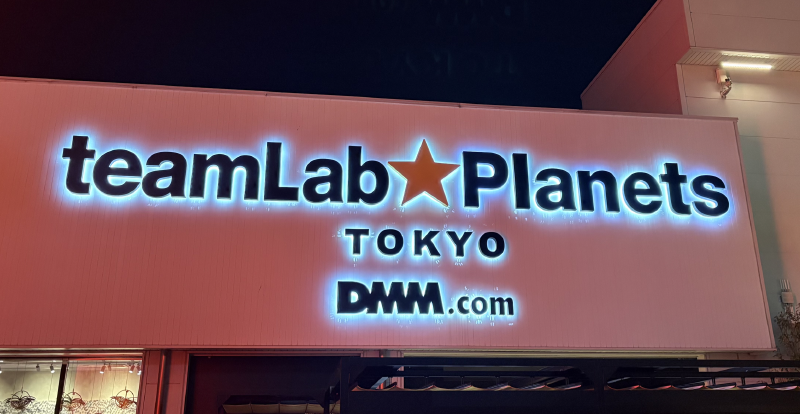
Planets itself is a large, blocky building that reads more as warehouse than destination from the outside - a giant logo on an otherwise unassuming facade, no indication of scale, no hint of the elevation changes and winding internal spaces that somehow fit inside it. From the street it looks like a place that receives shipments. From the inside it’s something else entirely. Inside, you move through a sequence of rooms, each one a completely different kind of sensory experience, and the whole thing is hard to describe to someone who hasn’t been there - not because the words don’t exist, but because the scale of it defeats language a little.
The Japlan, for all its faults, got one thing exactly right that day: we needed shorts. TeamLabs Planets involves walking through actual water in several of its installations, and entirely mirrored rooms in others. The Japlan had flagged this clearly enough in advance that we showed up dressed for it - shorts for me, shorts for the kids, and a quiet word to my wife that bike shorts under her dress would be a good idea.
This was validated almost immediately. Upon entry, you hand over your shoes and socks in a changing room, and then you’re directed into a tunnel heading upward on a gentle slope, water cascading down the ramp, with a proper waterfall waiting at the end. It was particularly satisfying to have spent real time planning something, and watch all that planning actually pay off for once.

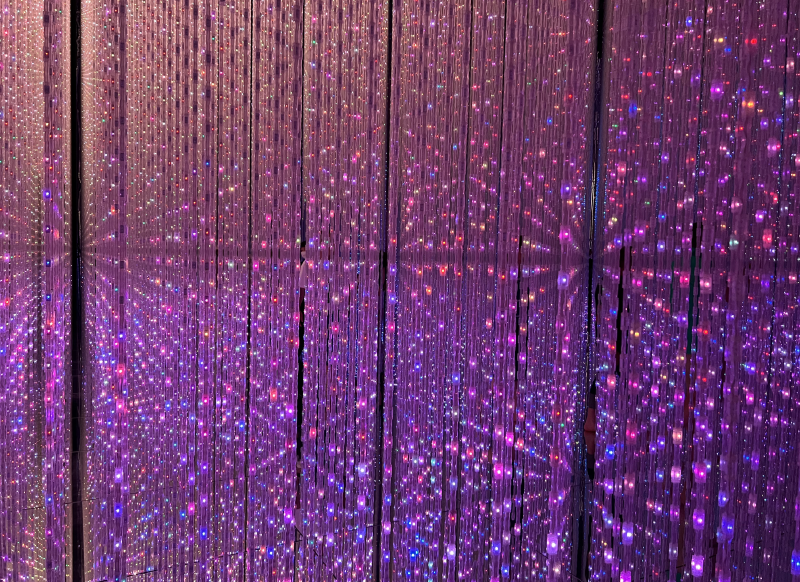
One room stopped me completely. Long cords of addressable RGB LED strips hang from the ceiling of a fully mirrored room - floor, ceiling, walls, all mirrors - and the lights shift and pulse in a way that creates an infinity cube stretching in every direction as far as you can see. If you’ve seen the ending of Interstellar, the sequence where Cooper is trying to communicate with Murph through the bookshelf suspended in that impossible space, it felt exactly like that - your brain insisting the scene can’t be real while you’re standing inside it anyway. I happen to know roughly how the technology works - yes, I’m that kind of nerd, yes I identified the LED strips immediately - and knowing that pulled me further in rather than out. Pictures genuinely don’t do it justice. Being there in person made me stop entirely and just be there, even after the rest of my family had already wandered off to the next room. I stood there longer than was probably reasonable. I felt something I couldn’t immediately name, and I’m still not sure I can name it now, except to say it was the good kind of disoriented.
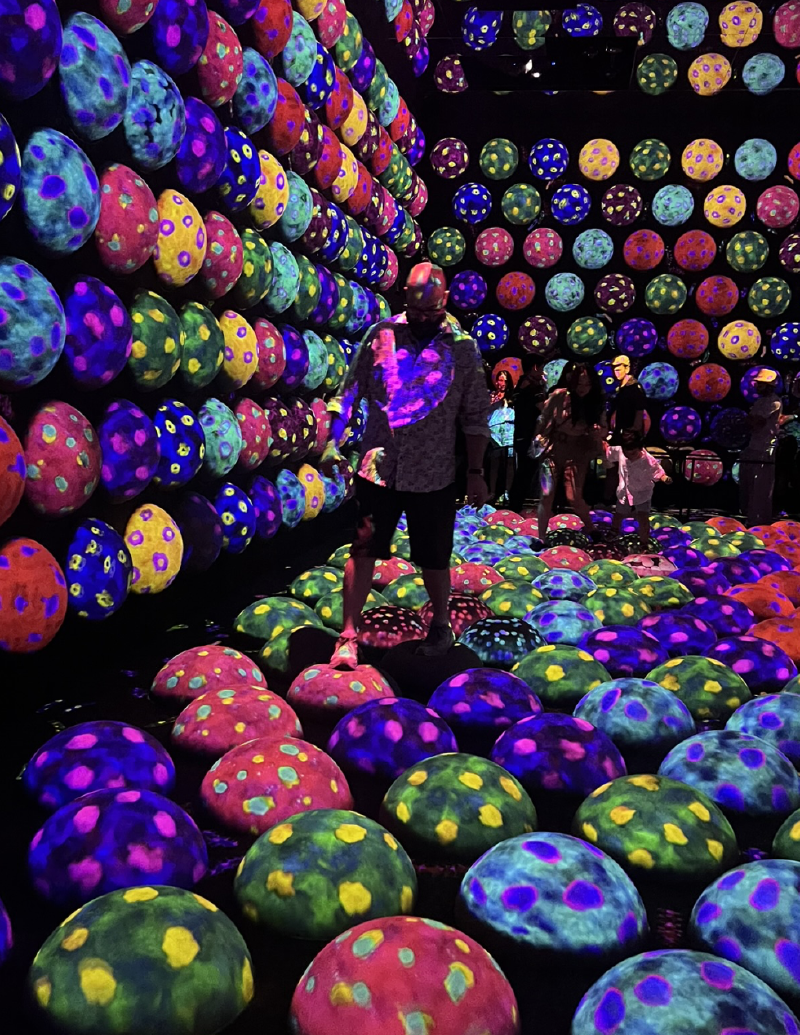
A close second was a room of real, living plants suspended in a mirrored space, rising and falling slowly on automated cables, alive and mechanical at the same time. They were flowering, which meant the room carried a faint scent of pollen you weren’t expecting until you were already standing in the middle of it. No single plant stood out to me individually. It was the whole thing - the same quiet “is this a dream” quality as the infinity room, just delivered through smell and slow motion instead of light and mirrors. Someone has to grow these plants, string them up, and keep them alive on cables in a room full of strangers. That part impressed me almost as much as the effect itself.
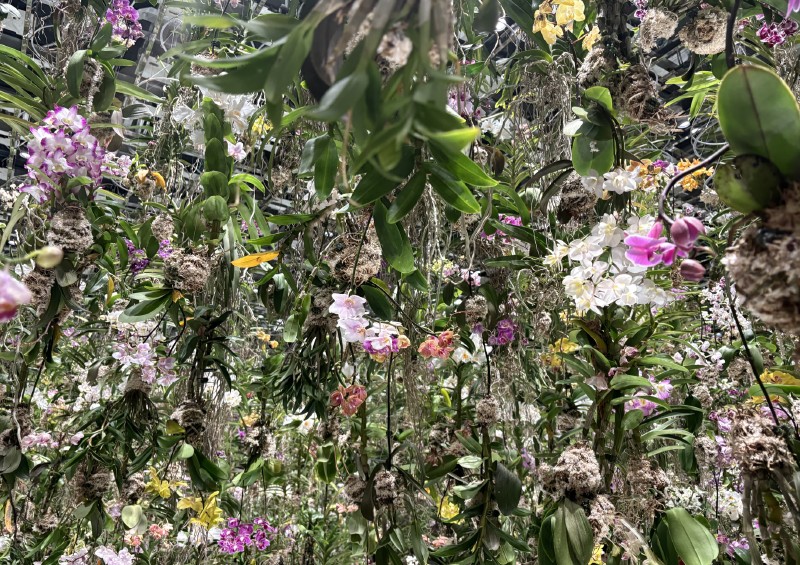
That wasn’t universally true. In the rooms leaning more on interactive projected art - the kind of installation where your movement triggers a response you can’t quite predict - knowing there was technology behind it actually pulled me out of the moment a little, because I spent too much time wondering how it was being tracked and rendered instead of just experiencing it. Funny how that works in two directions depending on what kind of system you’re looking at.
The water rooms were the most genuinely unique part of the whole experience. One large room uses mirrored walls to amplify its scale, filled with water about eight to ten inches deep, made cloudy with some kind of additive, with digital fish projected onto the surface so convincingly that they appear to swim around your legs as you walk through. It’s a remarkable effect, and it’s the single thing that put Planets ahead of every other TeamLabs experience we did on the trip. Nothing else we saw afterward managed to replicate it.
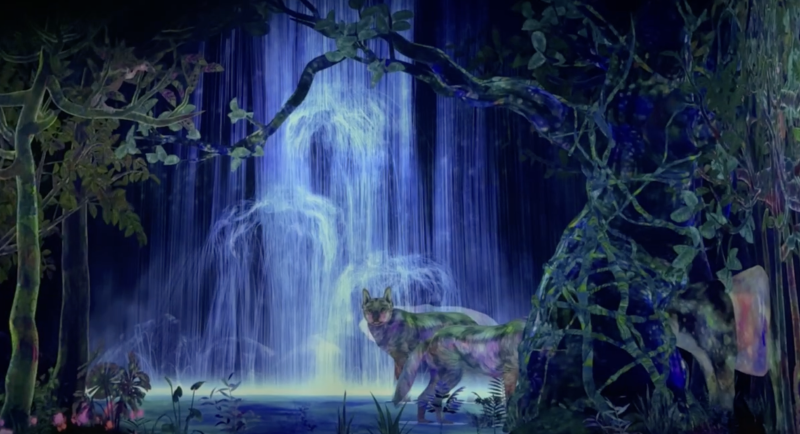
Every room carries its own soundtrack, much of it generative as far as I could tell, and it adapts in real time to whatever’s happening in the space. The whole experience was sensory overload in the best possible way. We left feeling like we’d genuinely seen something special, and if you only have time or budget for one TeamLabs experience in Japan, this is the one.
We hopped on the subway and headed back to the hotel. Both kids were asleep before we’d cleared the first stop, and we had to wake them up when we arrived. By the time we’d walked the few blocks from TeamLabs to the station they’d already been running on fumes. I don’t think we could have squeezed another hour out of that day even if we’d wanted to.
Later, when fact checking this post - I discovered that the new location for the fish market is on the same (small) island as TeamLabs Planets. It’s an ultra-modern, super clean market with an observation gallery for people wanting to watch the auction. Totally not what I found online when I was Japlanning. In a way, we “kind of” made it to both fish markets, without realizing it.