
It’s 4:00am and I Have Questions #
It was 4:00am on a Wednesday, and the neighbourhood was the kind of quiet that only exists in the middle of the week before the world wakes up. When the Uber pulled up - a Tesla, silently gliding to the curb like it was trying not to disturb anyone - it felt oddly appropriate. I’d never been in one before, and I had approximately four hundred questions about it that I managed to sit on for the first twenty minutes of the drive, because the man was working at 4:00am and didn’t need a passenger interrogation on top of it. Curiosity won somewhere around the ten minute mark before the airport, the questions came out, and he was gracious enough to answer them. If you’ve ever needed to satisfy a burning curiosity about someone else’s car at an unreasonable hour of the morning, I cannot recommend the experience highly enough.
I don’t think anyone actually slept that night - I know I didn’t, and when the alarm went off I suspect it found everyone already awake, staring at the ceiling and running through mental checklists. The kids were dressed and ready before I’d finished my coffee, which anyone who has tried to get a teenager out of bed before noon will recognize as a minor miracle under normal circumstances. There’s a version of me that has considered, on particularly difficult school mornings since we got back, shouting “hey, we’re going back to Japan, let’s go!” just to see what happens. I’ve never actually done it. But I’ve thought about it. The prospect of a fourteen hour flight to Japan apparently operates on motivational mechanics that a Tuesday morning simply cannot match.
Three flights stood between us and Tokyo. The first was a short hop to Toronto Pearson. The second got us to O’Hare in Chicago, where we had two and a half hours to kill. The terminal had the usual options, but we spotted a place doing takeaway deep dish pizza and that was the end of the discussion. I turned to the kids with the energy of a man who has been waiting his whole life to say this sentence: “You do know Chicago is famous for deep dish pizza. Since we’re here anyway!” It tasted like airport pizza, which is exactly what it was, but I went to Chicago and had deep dish pizza and that’s two vacation experiences for the price of one - like finding an onion ring in your fries. You didn’t order it, you didn’t expect it, but there it is and you’re not giving it back.
The third flight was fourteen hours to Tokyo Haneda on a Boeing 787 Dreamliner - the biggest plane I’ve ever been on - and I want to say something about long haul flights before I describe what happened on this one. A comedian once pointed out that people who complain about flying make no sense. You’re sitting in a chair. In the sky. You get in, and less than a day later you’re on the other side of the world. I’ve taken that to heart completely. Fourteen hours to Japan? Bring it on.
Now, about the seating arrangement. The Dreamliner has a 3x3x3 configuration, and I had what I considered to be a brilliant tactical insight: I convinced my wife to take a seat in the middle section where she’d have easy aisle access, while I sat with the kids. She could come and go freely, I could rotate the kids to the window, nobody was climbing over strangers. Clean, logical, elegant. She agreed surprisingly quickly, which in retrospect was my first warning.
My wife watched movies, napped, and chatted pleasantly with the seasoned travellers seated beside her. She had a wonderful flight.
I was solo parenting two relatively untested long-haul flyers on the longest international flight I’d personally ever taken, and I want to be clear about something: working in IT does not gaurantee I can fix your phone. IT professionals are just better googlers, and I was not in a position to google why the Netflix movie didn’t download properly, or why the $29 Target headphones wouldn’t pair with the seatback entertainment system. When tech doesn’t work, my kids get irrationally angry, and they come to me immediately because I work in tech. By some logic I’ve never fully understood, any technological failure is my fault. I fielded these concerns with the patience of a man who had been awake for twenty hours and was desperately trying to figure out how the neck pillow was supposed to work before the longest flight of his life. What I really wanted to do was loudly explain to everyone involved that they were experiencing the miracle of human flight and maybe just go with that - or, more importantly, get some sleep like the rest of the plane was doing.
My wife is a shrewd negotiator.
Welcome to Japan, Please Have an IC Card #
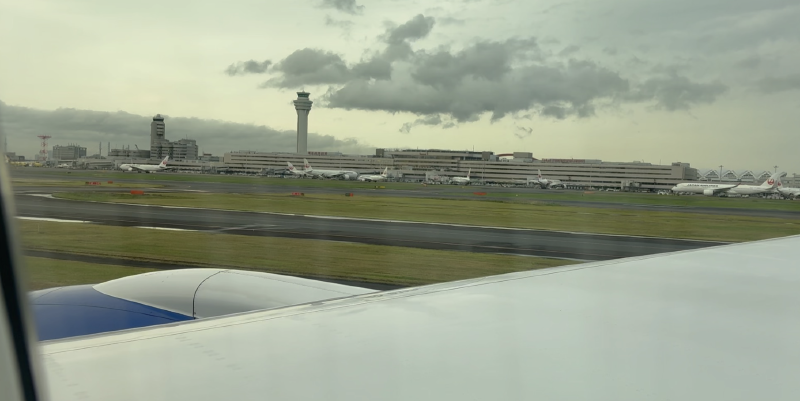
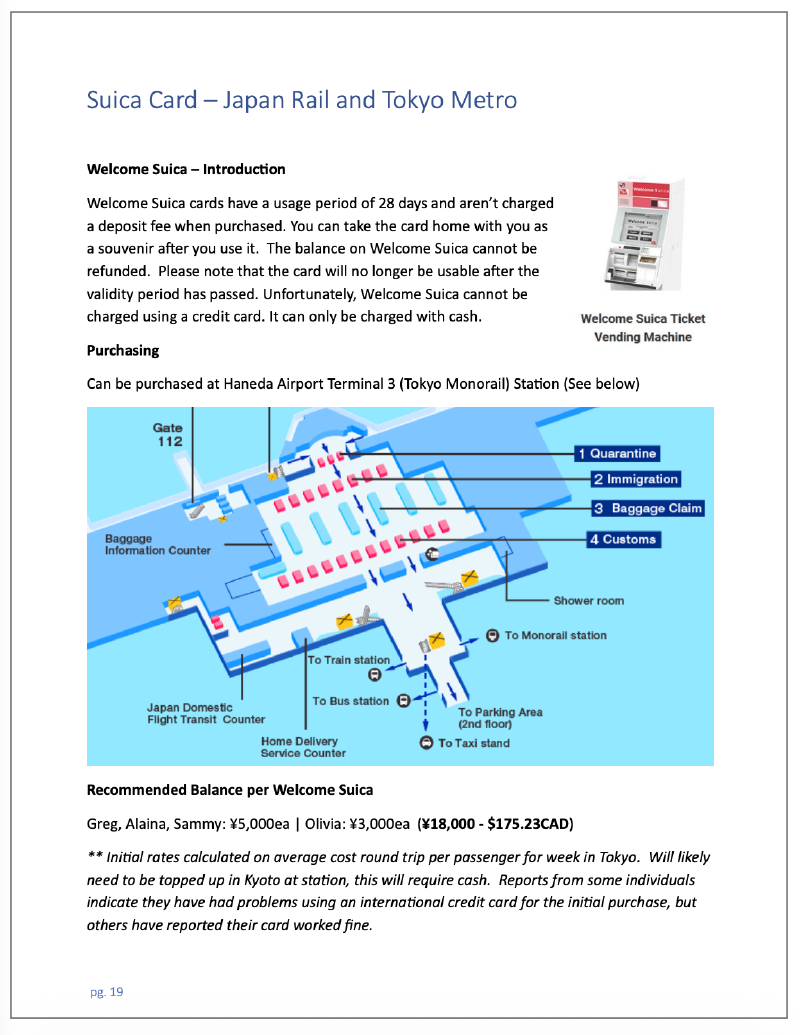
Haneda Airport is where we picked up our Welcome Suica cards - IC cards that work as contactless payment across essentially every transit system in Japan. The Japlan, naturally, had a full page dedicated to this, complete with recommended balances per person calculated in both yen and Canadian dollars, and a map showing exactly where the vending machines were in the terminal. I told the family I’d go sort it out, asked them to wait, and pointed at a perfectly good row of seats directly in front of us.
Spoiler alert: they did not sit in those seats.
There is no page in the Japlan for this, which I consider a significant oversight in an otherwise comprehensive document. 73 pages of preparation - annotated airport maps, gate predictions, which door to use on the bus in Kyoto - and not one of them covers the scenario where your family silently relocates to an undisclosed position in an unfamiliar airport in a foreign country while you’re standing in a lineup. I have since identified this as a gap in the documentation.
The lineup itself was longer than expected, because it turns out that “get your IC cards at the airport” is everyone’s brilliant idea simultaneously. By the time I’d procured four cards and made it back, the family wasn’t where I’d left them, their international SIMs weren’t activated yet so I couldn’t call anyone, and we had cleared customs approximately twenty minutes ago. I conducted a frantic ten-minute search of the terminal that I would describe as controlled panic, found them, and exercised what I believe to be remarkable restraint in my reaction. At least not too badly. I hope.
There’s a side effect to being the person who does all (* most -if my wife ever reads this I know this will become a sticking point) the pre-trip research that I hadn’t fully anticipated - people start to assume that the research extends to everything, including things that cannot be researched in advance. We’d had a version of this on the way home from Iceland, where my wife kept asking me which door to use and where the shops were in Keflavik airport, and I had to explain that just like her, I had never been to Keflavik airport before. Technically we had, briefly, on the way in - but I’m not counting that as “experience”. The same dynamic played out at Haneda. The Japlan knew where the IC card machines were. The Japlan did not know where my family had gone, because the Japlan assumed they’d stay where I left them, because that seemed like a reasonable assumption at the time. I’m torn on all of this - there’s something validating about people assuming you know more than you do, and something exhausting about being the designated person who is supposed to know everything. The Japlan was meant to do the hard thinking so I could be on vacation.
It turns out the hard thinking never really stops.
Must Resist the Urge to Wrestle #
We’d arranged an airport limo from Haneda - not a limo, just a comfortable car with a professional driver - specifically because we’d heard enough horror stories about foreigners trying to navigate Japanese public transit loaded down with luggage. It was, as far as I could tell, the only vehicle in Japan large enough to actually fit everything we’d brought. Every other car we took for the rest of the trip involved the driver opening the trunk, taking a long look at our bags, and folding a seat down in silence. Tipping isn’t a thing in Japan, which I respect enormously as a cultural stance, but it did mean that as each driver surveyed our luggage situation I could almost hear the thought forming: “there is no financial upside to this whatsoever.”
The drive into the city took about an hour, and I found myself in the front passenger seat making small talk with the driver - a position I would occupy for essentially every car journey for the rest of the trip, which I initially assumed was coincidence and later found out was by design. Japan drives on the left, which means the front passenger seat offers an unobstructed view of what appears, to a North American brain, to be oncoming traffic. My wife had made an executive decision that if certain death was approaching, she’d rather not have advance notice, and had positioned herself in the back accordingly. There was also the small matter of logistics - I’m six feet tall and my family tops out at around five foot two, so the seating arrangements in every vehicle we took were less a matter of preference and more a matter of geometry. Even the front seat felt snug at times. I assumed the left-hand traffic would be a bigger adjustment than it turned out to be - I only reached for the imaginary brake pedal two or three times across the entire trip, which I consider a personal victory. Japanese drivers change lanes with a frequency and confidence that takes some getting used to, but I loved being up front. Interesting tech in the cars, conversation with the driver when it was possible, and an unobstructed view of everything. Some people use a commute to nap. I’d spent the better part of a year planning this trip and I wasn’t about to miss a single thing out the window.
The Dai-ichi Hotel Ryogoku is exactly what it looks like online - a perfectly comfortable western-style hotel in the Ryogoku district, which is the sumo district, which becomes relevant immediately upon entering the lobby. There is a full-size sumo ring embedded in the floor. Regulation dimensions. Right there. I believe it’s intended for guests to appreciate the scale of the sport in a tangible way, and standing at the edge of it I briefly entertained the idea of squaring off against someone - my wife, maybe, or one of my kids - before remembering that this is Ryogoku and the hotel has almost certainly put a professional sumo wrestler on standby behind one of those unmarked doors for exactly this kind of tourist impulse. I stepped back from the ring. It was the right call.
Check-in involved two people pointing phones at each other for several minutes, both using Google Translate, neither entirely sure the message was getting through. The staff were lovely and the system worked well enough - I walked away with a room key and a mental note to pre-load some useful phrases for the rest of the trip. Things like “which way to Akihabara?”, “where is the nearest convenience store?”, and “my family appears to have wandered off, please help.”
I want to say something about the language barrier, because my instinct going in was to find it stressful, and instead I found it oddly thrilling. I’ve travelled before, but always to places where English is at least partially expected. Standing in a hotel lobby in Tokyo with no shared language except whatever Google decided to translate, in a building that looked like it could be a Holiday Inn except for the sumo ring - it felt like we’d really gone somewhere. Like this was the actual adventure starting.
The Volume Knob Remains a Mystery #
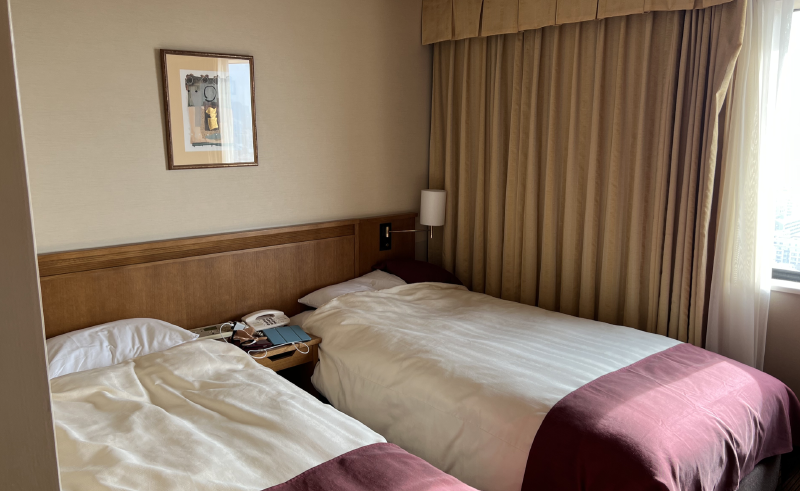
The rooms were a good size - meaningfully better than the chain hotel we’d originally booked and cancelled, which had looked barely large enough to fit our luggage let alone us. We’d requested adjoining rooms with a connecting door. We received adjoining rooms. The connecting door did not materialize - lost in translation, or possibly just not a concept that exists here - so my wife and I were each in our own room with a kid apiece.
My room had a bedside console with what appeared to be an AC controller from roughly 1987. No snowflake symbol, no blue-for-cold, nothing that corresponded to any North American interface convention I’d ever encountered. I ran it through Google Lens, got back a translation that was technically a real English word but bore no obvious relationship to temperature management, made my best guess, and it worked. It did not occur to me to mention any of this to my wife before she went to sleep next door.
Her first night in Japan was spent in conditions I can only describe as aggressively humid. I felt bad about this. Not bad enough to have checked in before she went to bed, but bad about it retroactively.
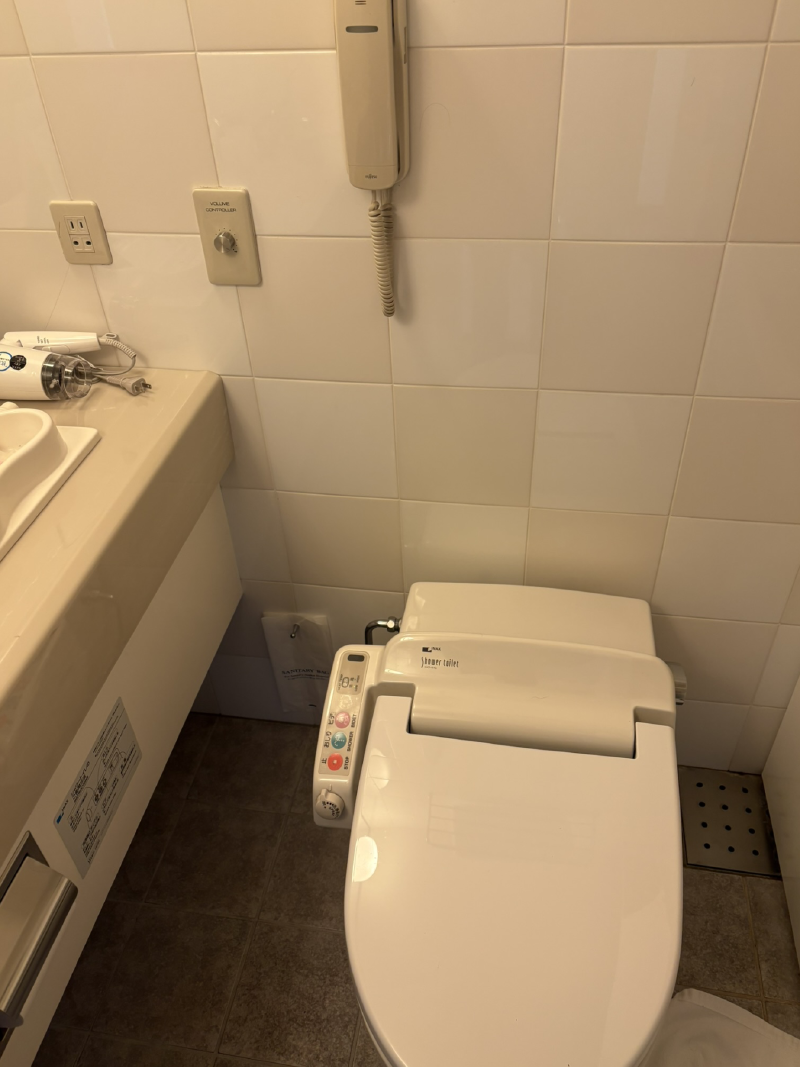
The bathroom also contained a phone, which I want to address directly. There was a phone. In the bathroom. Mounted to the wall, corded, clearly functional. There was also, beside it, a panel labeled VOLUME CONTROLLER - a knob, of unknown purpose, controlling an unknown volume of an unknown thing. I thought about picking up the phone every single time I went in there and never once did it, because my working theory was that it connected directly to the front desk and an immediate hang-up would trigger a wellness check I was not prepared to explain. The phone went unanswered for the entire week. The volume knob remains a mystery.
Japan runs on 110V AC, which is the same as North America and meant no adapters needed - a small gift I was grateful for. I did notice that the outlets had no grounding prongs, which is the kind of thing a normal person would observe and immediately forget, and which I could not stop thinking about for the rest of the trip. Japan has solved so many things so elegantly. Ungrounded outlets, apparently, is where they drew the line. I chose not to dwell on it.
It Was Still Daylight (And We Had a Mission) #
About two hours after checking in, I made a unilateral executive decision: we were not going to bed.
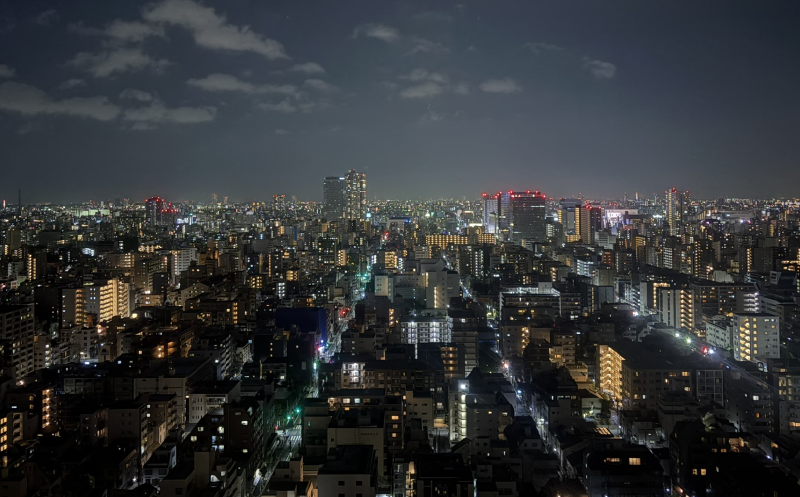
The sun was still up, but the real reason I wanted to go to Akihabara that evening specifically was to see it at night - the neon signs, the giant multi-story billboards, the illuminated displays stacked floor to ceiling on buildings that seem to go up forever. I’d seen that aesthetic on the big screen plenty of times - Blade Runner, Cyberpunk, every rain-soaked neon-drenched future cityscape Hollywood has ever committed to film - but I wanted to actually stand in it. Hear the sounds, feel the energy, be in the middle of it rather than watching it from a seat. The real thing, but with way less grit and cybernetic implants. Some people go to Times Square for that kind of sensory overload. We went to Tokyo because Tokyo was the version we actually wanted, and it was sitting two stops away on a train. In retrospect I feel fairly strongly about this, which makes it all the more embarrassing that I never officially baked an evening Akihabara visit into the Japlan. The opportunity presented itself, and we took it.
I also had a secondary motivation, which I’ll admit freely: somewhere in Akihabara, possibly on Day One if we were lucky, was a specific figure of Monoma from My Hero Academia - his signature unhinged villain laugh pose - that my oldest daughter had designated as her one meaningful thing to find and bring home from Japan. We’d made this assignment before we left, having learned in Mexico that left to their own devices the kids would spend their entire budget on novelty keychains by day two. Each of them had to identify something specific, something worth looking for. My daughter knew immediately. Monoma. The laughing one.
We did not find Monoma on Day One, or Day Two, or at any point across the thirty-five figure stores - conservatively - that we visited in Tokyo, Nakano, and Kyoto over the following two weeks. The hunt became its own subplot, running beneath everything else we did. But that comes later. On Day One, we just knew we were going to Akihabara, and we were optimistic.
Ryoguku is Not Ryogoku #
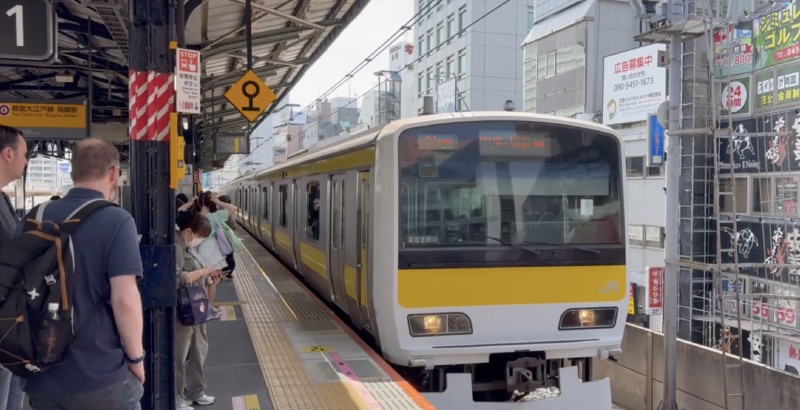
Here is a thing I did not know before arriving in Ryogoku: there are two train stations in the immediate area. Ryogoku - with the JR east-west line that would take us directly to Akihabara in two stops. And Ryoguku - a different station, a different line, running north-south, going nowhere near where we wanted to be. One letter difference. Completely different stations. The Japlan, for all its thoroughness, did not flag this distinction.
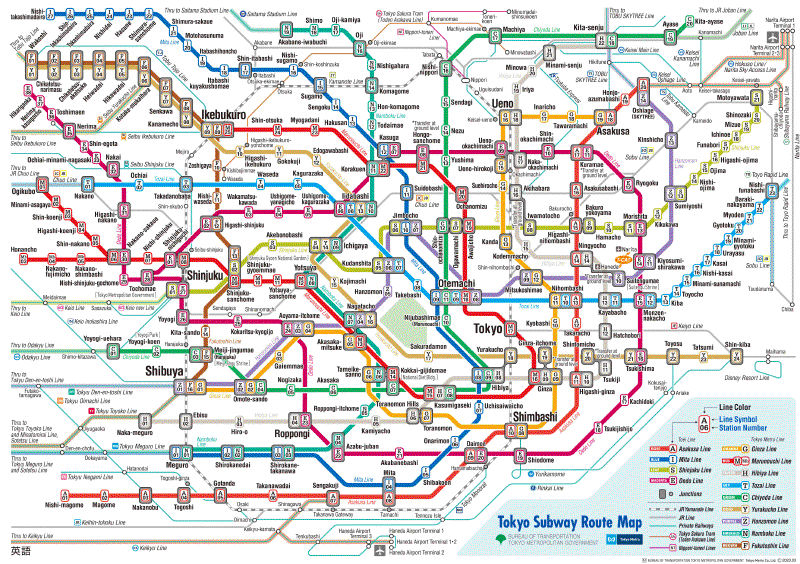
We tapped our IC cards, walked through the gate, and looked at the platform signage - the helpful display that tells you which direction goes where, what stops are coming up, what you can connect to. I know how Akihabara is spelled. None of those said Akihabara. I pulled out my phone, opened Google Maps - which works exceptionally well in Japanese subway stations, a fact I wish I’d leaned on about three minutes earlier - and confirmed what the signage was already telling me. We were on entirely the wrong line, on the wrong side of a fare gate we couldn’t simply un-tap our way back through.
Oh no.
The gate, as it turns out, does not work in reverse. We stood there for a moment processing this, then went to find a station worker - who was in a booth behind glass, the kind with a small hole in the window to speak through, which added a second barrier to the first one we’d already created for ourselves. He couldn’t speak enough English, I couldn’t speak enough Japanese, and Google Translate wasn’t particularly useful when you’re trying to type through a small hole in a pane of glass while a tired man waits on the other side. What saved us was the fact that this was clearly not his first rodeo - he knew exactly what we’d done the moment we appeared at his window.
I was hoping we might be able to get a refund to our IC cards, which I wasn’t even sure was possible, and had mentally prepared myself to just absorb the cost as a life lesson if it wasn’t. When he started to get visibly frustrated I assumed, in the moment, that he was annoyed at the audacity of the ask. Looking back, I think the reality was simpler - he was trying to process the refund and we weren’t following his directions, which were being given in Japanese, which we did not speak. He knew exactly what needed to happen. We kept getting in the way of it happening. Nobody was at fault, really - just two parties trying to solve the same problem from opposite sides of a language barrier and a pane of glass. Eventually the cards were processed, the refund happened, and he sent us on our way.
We Are Not in Canada Anymore #
The north-south Ryoguku station, for what it’s worth, has a very specific atmosphere - liminal, slightly unsettling, the kind of place where you feel like something is just slightly off. I didn’t know about Exit 8 when we were there - it’s a horror game that went viral for perfectly capturing the vibe of a Japanese subway station, and I only played it for the first time recently. In retrospect, I’m glad I hadn’t played it before the trip. A lot of Japanese subway stations match that atmosphere exactly, and I would have been second-guessing my sanity every time we went underground. The east-west JR line that we eventually found feels different - elevated, open air, more functional than atmospheric. Nice enough, but not the “oh we’re definitely in Japan now” feeling we were after.
Akihabara station is the “oh we’re definitely in Japan now” feeling.
It’s enormous. Escalators in every direction, food options everywhere, anime advertisements covering every available surface, and on every single escalator - every one - a sign warning about people taking upskirt photos. Bluntly worded, matter of fact, not a suggestion. I have theories about why this is specific to Akihabara. Most of them involve maid outfits and cosplay. The theories remain untested and will stay that way. I wanted to photograph the signs as documentation but never found a moment in four visits when the crowds were sparse enough to make that feel like a reasonable thing to do. You’ll have to take my word for it.
After thirty-five years of wanting to go to Japan, standing in Akihabara station on the first evening with the family, it suddenly felt completely real.
One Hundred Dollars of Tiny Plates #
By the time we actually made it to Akihabara, the evening had taken on a slightly different energy than I’d planned. The subway incident had sobered things up a bit - we were tired, we’d been awake for most of a day, and the excitement of being in Japan had been replaced by the more immediate reality of being hungry and slightly frazzled in a place we’d never been before. We did a quick circuit of the main strip, took in the neon and the billboards and the sheer sensory overload of it - which delivered everything I’d hoped for, even in our diminished state - and then the family started fading fast into hangry territory and decisions needed to be made quickly.
I’ll write about Akihabara properly another time. What Day One taught us was the tourist restaurant lesson, which I’ll get to in a moment, and the fact that even at less than full capacity, even after a subway disaster and twenty-two hours of travel, Akihabara at night is exactly what you’d hope it would be.
I’ll admit that food was one area where the Japlan let me down - or more accurately, where I let the Japlan down by not planning it properly. I’d sorted the transit, the hotels, the IC cards, the airport gate probabilities. I had not given a lot of thought to where we were actually going to eat. So when we got hungry in Akihabara, we did what hungry people do and picked the first place that looked good.
What caught my eye specifically were the display cases outside - the ones with hyper-realistic plastic food models showing exactly what each dish looks like. At some point in my past, I’d listened to an episode of The Ongoing History of New Music where Alan Cross explained the whole phenomenon - how Japanese restaurants display incredibly detailed fake food instead of printed menus, how it became a massive industry, how remarkably common it is. I had this information stored somewhere in my brain and the moment I saw the first display case it evaporated completely, replaced entirely by “oh wow look at that, I totally forgot about this!” We went in. Typical tourist.
One hundred and twelve Canadian dollars. Two drinks. Plates that were charming in presentation and modest in portion. Every travel forum about Japan will tell you the same thing - walk thirty seconds off the main strip and the food gets dramatically better and cheaper. Every travel forum about Japan is correct. We know that now, although if I’m being honest, we had to rediscover it a few times across the trip through what I’ll generously call repeated experimentation. We never had a bad meal at the tourist spots - every meal in Japan was enjoyable - but the portions were smaller, the prices were higher, and the experience was just a bit less than what was available thirty seconds in any other direction. The lesson wasn’t so much learned as it was slowly reinforced over two weeks of fieldwork.
I Don’t Know What I Expected #
Getting back to the hotel was the same process in reverse - and this time, having learned our lesson, we got on the correct train without incident. Small victories.
The walk from Ryogoku station to the hotel is actually worth mentioning, because it turned out to be one of the understated good moments of the day. There are shops and sights along the way, people coming and going, the general rhythm of a neighbourhood doing its evening thing. The closer we got to the hotel the quieter it became, and for a stretch of that walk we were just moving in the same direction as everyone else at the end of a weekday - not tourists consulting a map, just people heading somewhere. It’s the kind of feeling that’s hard to explain without resorting to “you had to be there,” but there’s a trick you can play on yourself when you’re moving with the flow of daily life in a foreign city rather than against it. For a few minutes, it felt like we belonged there.
Back at the hotel, I had another look at the bathroom phone, decided against it, and got in the shower. The water pressure was phenomenal - inexplicably good, the kind of shower that resets something in your brain after twenty-two hours of airports and airplane seats. I don’t know what I was expecting but it wasn’t that.
I went to bed having been awake for most of a day. Japan had been open for business for approximately four hours and had already exceeded expectations on essentially every front.
Day Two was going to be something.