
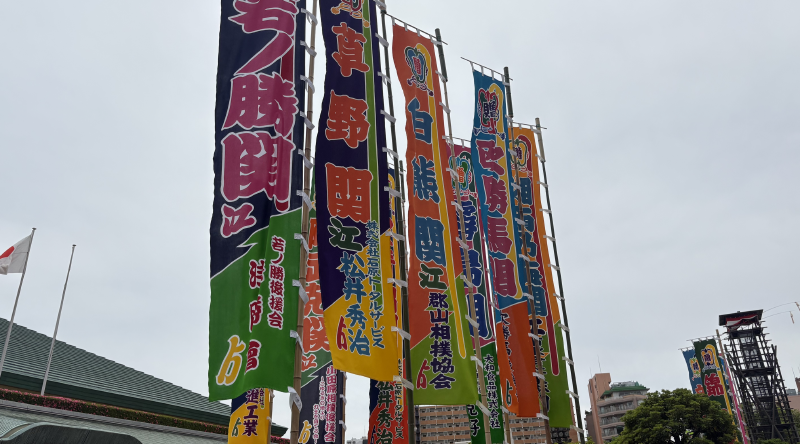
For me, the process for booking our hotel in Tokyo was agonizing. I’m not wired to just show up and roll with the punches, so I obsessed for days over the decision. I knew it’d be our base of operations for a week, and picking the wrong hotel could ruin the entire experience. Opinions on forums and travel sites about which Tokyo district and hotel to pick varied wildly. Based on what I was willing to spend, and what I assumed to be roughly centrally located in a massive city I’d never been to before, I kept landing on Ryogoku. The problem with Ryogoku was that not one travel site or forum mention how fantastic it actually is. I booked the hotel in Ryogoku anyway because it checked every box, but I was still convinced I’d made the wrong decision. In the months leading into the trip, I asked my wife more than once if we should look at a different hotel elsewhere. She must’ve known something I didn’t - she told me that the hotel I’d picked was likely fine and there was no need to change. For what it’s worth, I’m glad I listened to her, and would absolutely book in Ryogoku again, at the same hotel. It was the perfect base of operations.
As part of my obsessive planning, I discovered that we were practically next door to the Ryōgoku Kokugikan. I had no idea when we’d booked that this was one of the main Sumo arenas in Japan. I also had no idea that we’d booked during the exact week of the Grand Sumo Tournament in Tokyo. Grand tournaments happen a handful of times a year, one week at a time, and our trip happened to land squarely inside one of those weeks without us planning a single part of it that way. Needless to say, the odds of this happening were not in our favour. The second I understood how unlikely it was, I understood exactly how unforgivable it would be to let it slip past us.
I remember excitedly telling my wife, with the kind of conviction usually reserved for much more important announcements, that this was fate - that we’d thrown a dart at a board blindfolded and somehow landed a bullseye, and the universe doesn’t hand you a coincidence like that twice. She agreed, mostly to get me to stop talking about it, despite not being all that sure she wanted to spend an entire day watching a never-ending stream of large men in loincloths.
So I treated buying tickets the way I’d treat a production incident at three in the morning - full focus, full urgency, the unshakeable conviction that failure here was not an option I was willing to entertain. I marked the ticket sale date in my calendar like it was a launch window (even taking into account the time difference to ensure I was in the queue at the right time).
The Ticket Scramble #
Tickets for the Grand Sumo Tournament go on sale online, in Japanese, on a website that was very clearly built by people who never once imagined a panicking Canadian on the other end of it. The sale opened at 9pm local, which was 10am the next day in Tokyo. (If you can believe it, the concept of time zones still amazes me).
At the appointed time, I queued for the tickets. Immediately, the site crashed. I queued again. It crashed again. At this point I did what anyone in my line of work would do when faced with a system failing under load: I started troubleshooting it like it was my own infrastructure. Different browser. Incognito mode. Different device. A laptop, then a second laptop, then my phone, then back to the first laptop because surely it just needed a minute to cool off. The site crashed with a consistency that started to feel less like bad luck and more like a personal grudge it had developed against me specifically. Two hours in, I gave up, told myself it clearly wasn’t meant to be, and tried very hard not to notice how that sentence directly contradicted the whole fate speech I’d given my wife forty-eight hours earlier.
We went to bed defeated.
At 2am, I woke up. No alarm, no reason, nothing - I just surfaced out of sleep with my eyes open and a single thought already waiting for me: one more try. I picked up my phone, half-convinced I was about to confirm the whole thing was dead, and the site loaded. No crash, no spinning wheel, nothing dramatic. It simply worked, the way it apparently should have worked the entire time.
What followed was several of the most frantic minutes of my life. I was in the checkout flow, tickets available and in my cart, and then I hit the payment step and realized with total clarity that my wallet was downstairs. Terrified that I would miss out on the tickets, I flew downstairs, likely waking up the entire house in the process. Wallet in-hand, I got back to the screen, heart rate still elevated, and bought the best tickets the website would let me have, plus what I can only describe as a $20 (each) foreigner surcharge I paid without a second of hesitation, because it was 2am and I was not about to start negotiating ticket pricing with a website that had spent hours actively fighting me.
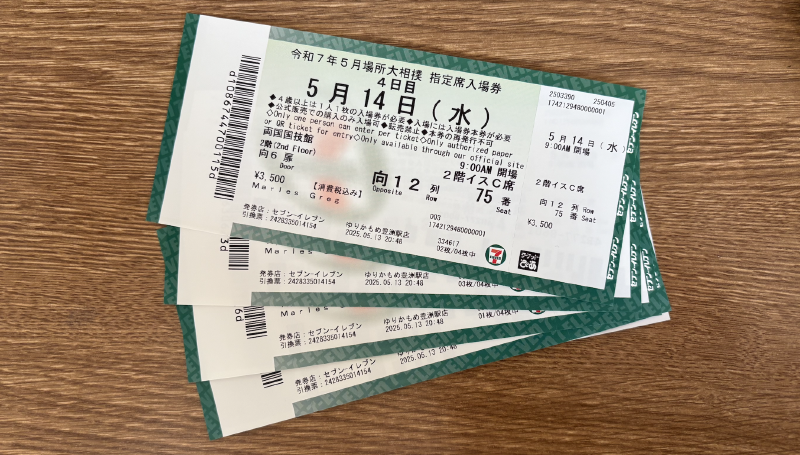
I received the confirmation email in my inbox. We were going to sumo.
Arrival #
The tournament runs fifteen days. We had tickets for exactly one of them, which turned out to mean something closer to a full workday than a single event - matches starting in the morning and running more or less continuously until evening, the building filling in slowly as the stakes climbed alongside it.
We had no idea what we were doing. This became obvious almost immediately, in the way that only becomes apparent once you’re already sitting down and the first match has started and you realize you’ve spent more time researching hotel AC units on this trip than you spent researching the actual sport you bought tickets to watch. We knew the premise in the broadest possible strokes - two very large men, one ring, first one out loses. We did not know that you could legally pick another human being up by their underarm fat and walk them bodily out of the ring, which is apparently a real and occasionally deployed technique and not something I’m certain I needed to learn. We did not know about the salt throwing, or the belly slapping, or the pre-match rituals that routinely outlast the matches they’re preceding. We did not know about the processions of banner carriers who parade through before the bigger bouts, advertising sponsors with a level of formality and ceremony that makes a logo patch on a jersey look almost embarrassingly casual by comparison.
The posturing, it turns out, is the whole point. Two wrestlers can spend five full minutes circling, resetting, throwing salt, staring each other down with the patience of men who have nowhere else to be - and then the match itself lasts eleven seconds. Somehow that math works in the sport’s favour rather than against it. The eleven seconds hit harder because of the five minutes, not in spite of them.
I should clarify that I’m not typically one to eavesdrop on other people’s conversations, but fate again worked in our favour. Seated directly behind us were a handful of people conversing in English about the mechanics of the sumo tournament. One of the members of the group worked for a company with an office in Tokyo, and said that whenever they were in Japan, they’d go to sumo whenever possible. Thanks to their conversation, and my casual eavesdropping, we were able to pick up the basics of what was happening.
The Headache, and the Best Bad Decision of the Day #
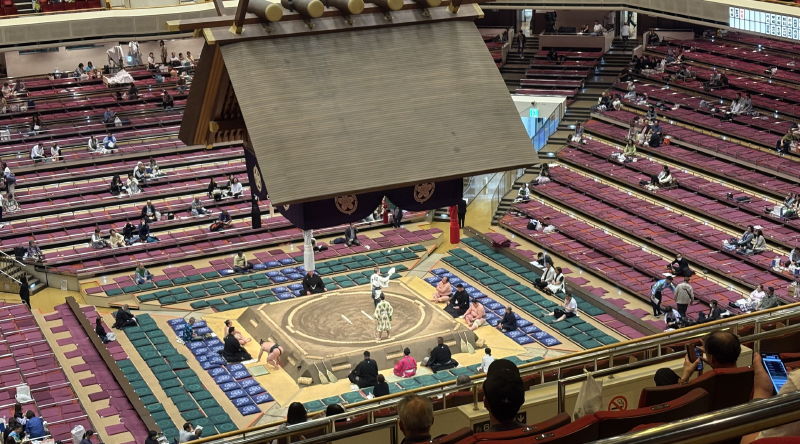
Somewhere in the early afternoon, with the arena still sitting at maybe twenty percent capacity and the matches still warming up rather than building toward anything, I started to feel a headache coming on - the specific, unmistakable kind that I knew from experience was not going to improve by sheer force of will. I floated the idea of heading back to the hotel for a bit. Nobody fought me on it. The matches happening at that point were fine, pleasant even, but they weren’t the ones anyone had circled on the calendar, and an underfilled arena in the early afternoon is a much easier thing to walk away from than a packed one in the evening.
Back at the hotel, I did what I always do, the same ritual every single time: Tylenol, a cold cloth over my eyes, and the bedside AC unit - the same one with the 1987 console and the Google Lens translation that had technically worked but corresponded to no temperature setting I could explain - cranked up as far as it would go. Then I lay there and waited, the way you do, half-praying to whatever deity handles minor head pain and travel logistics simultaneously. About an hour later, the headache had mostly let go of me. Mission accomplished, more or less by accident.
What I didn’t fully appreciate until later is that the headache had done us a genuine favour. We hadn’t just rested - we’d skipped the slow part entirely.
The Return #
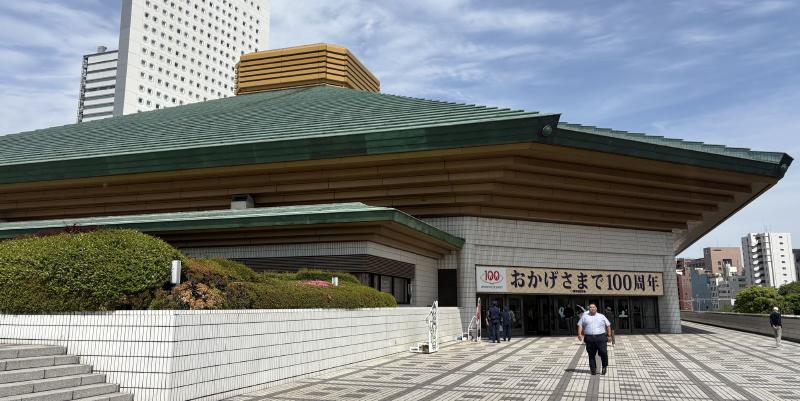
On the walk back to the arena, we passed a fresh wave of wrestlers arriving for the afternoon session - some on foot, some, improbably and magnificently, on bicycles, all still in their kimonos. It hadn’t occurred to me that morning that we’d missed this entirely; by the time we’d arrived the first time, everyone was already inside. In North America, a celebrity sighting is an event, documented from six angles and uploaded within the hour. In Ryōgoku, a man built like a small car cycled directly past us in traditional dress and not a single person reacted. It felt like the most normal thing happening, which somehow made it the most surreal thing I saw all day.
We walked back into the Kokugikan to a completely different building than the one we’d left. The arena that had been a quarter full when we ducked out was now sitting somewhere around eighty percent, the energy in the room having climbed steadily while we were gone without us. The matches had gotten bigger, the crowd louder and more locked in, and - maybe best of all - the kids were suddenly far more engaged than they’d been in the morning, because there’s only so much five-minute staring-and-salt-throwing a kid can watch before the spectacle of it starts to land. An hour away and a full house had done what no amount of pre-match explanation from me ever could have.
As the day wore on, the building kept filling and the matches kept climbing in weight, the crowd building toward something we couldn’t quite name yet but could absolutely feel coming.
The Final Match #
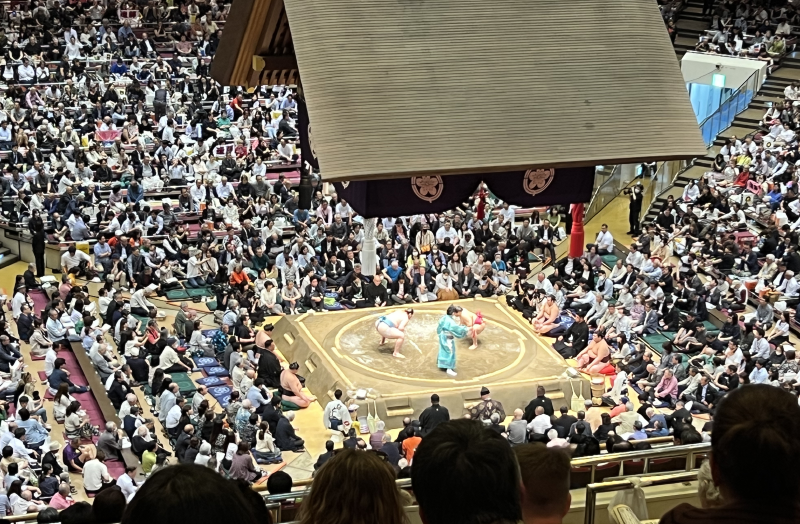
The last match of the day arrived with the entire arena already standing on the edge of something. We still had no real idea what we were watching in any technical sense - who was favoured, what the stakes actually were, whether we were about to witness a coronation or an upset nobody saw coming. None of that mattered. We watched anyway, completely locked in, the way you do when a room full of strangers all decide to hold their breath at exactly the same moment.
The match ended, and the entire arena absolutely lost its mind.
Cushions - the flat seat cushions everyone had been sitting on all day, the kind you forget are even there until they’re airborne - went flying into the ring from every direction. People were on their feet, yelling, arms up, filing toward the exits in a kind of controlled chaos that didn’t look controlled from the inside of it. To this day, we genuinely don’t know whether the result was the one the crowd wanted or the exact opposite. It didn’t matter. It remains one of the most electric rooms I have ever stood inside.
Of the four of us, my wife - the one who’d agreed to the whole thing skeptically, mostly to get me to stop talking about it - loved it the most, by a wide margin. I was right there with her. The kids were fine with it, which is a polite way of saying it didn’t crack their top five moments of the trip. For her, it was an honest highlight, which still amuses me given how much convincing it took just to get her in the building.
Television Doesn’t Get It #
I watch sumo on television now, on the rare occasion I remember the tournament’s running. It’s not the same, and I don’t think it’s supposed to be. The broadcast trims the preamble, speeds past the rituals, gets straight to the part where two large men collide. I understand the editorial logic. I also think it guts the sport of the exact thing that makes it worth watching in person - the staring, the salt, the five minutes of nothing that makes the eleven seconds of something land like a gunshot. Strip all of that away and you’re left with a highlight reel that explains nothing about why an entire arena just lost its collective mind over a man falling out of a ring.
You don’t get it from a couch. You get it from sitting in a quarter-full building in the early afternoon, leaving because your head hurts, coming back to find the whole thing transformed, and standing in a crowd that’s throwing cushions at a result you’ll genuinely never find out the meaning of. That’s not a flaw in the day. That, it turns out, was the entire day working exactly as it should have - including the part where I had a headache.